US burger chain tries to shake ‘premium’ image in a country that prefers chicken
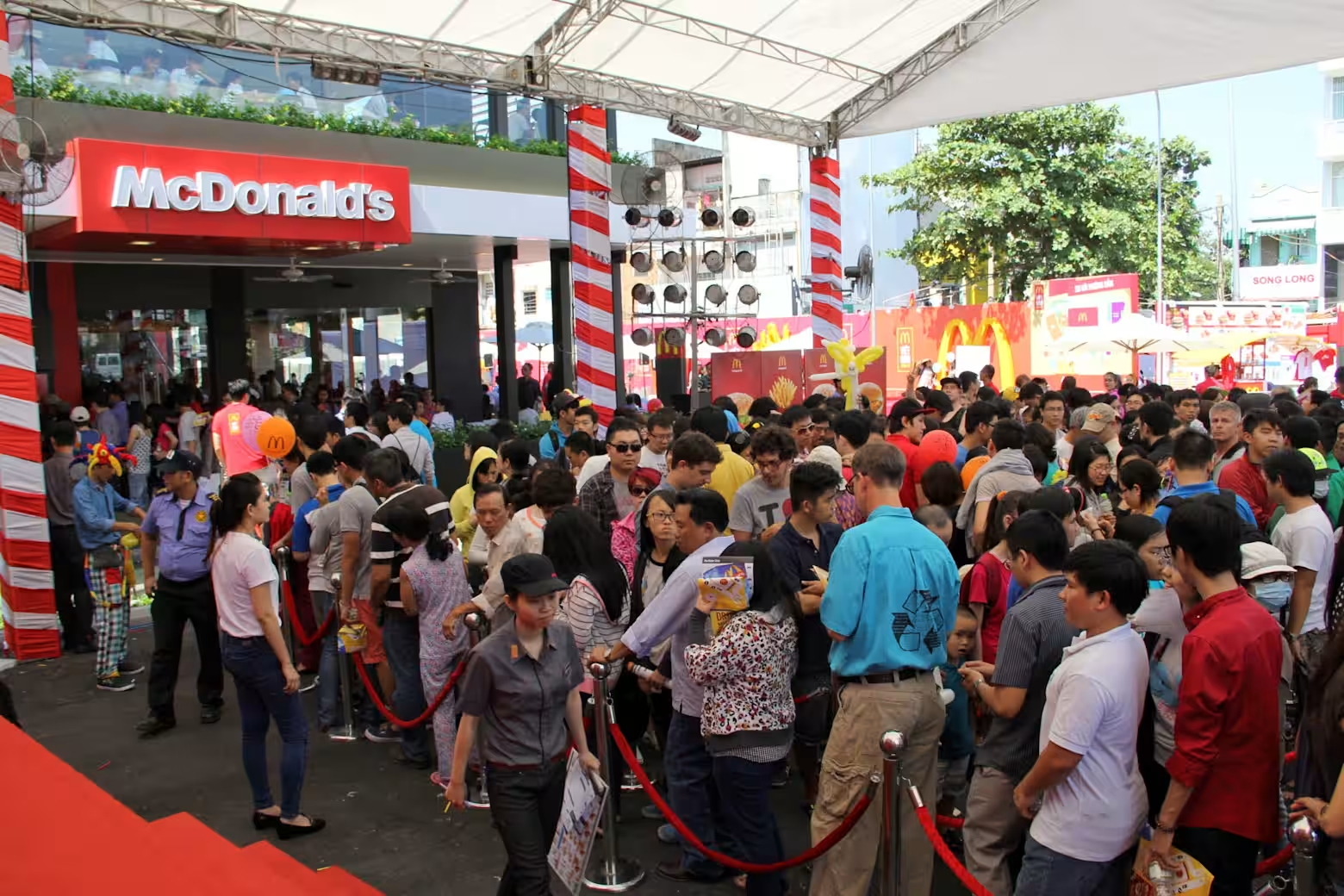
HO CHI MINH CITY — Last year, a market researcher pegged McDonald’s Vietnam as having a “premium image.” The fast-food juggernaut agrees, and it’s not entirely thrilled.
McDonald’s aims to have 100 stores in Vietnam in about three years, a tall order for a business that is up to 39 eateries 12 years after Henry Nguyen, a son-in-law of a former prime minister, brought it to the country.
To hit that goal, the burger chain aims to remake its image and go mass market, Dan Ta, McDonald’s Vietnam chief development officer, told Nikkei Asia.
“Our brand is perceived as a premium store,” Ta said. “We want to be able to serve the mass audience.”
This means potential discounts and expanding to second-tier cities like Phu Quoc, where Ta sees opportunity now that the popular island has a new airline and plans to host APEC 2027.
Analysts say the company hasn’t adapted sufficiently to Vietnam, where people prefer chicken over beef and have plenty of healthy, cheap alternatives such as the traditional banh mi sandwich

Vietnam also has other fast-food chains. Lotteria, a South Korean burger place, has 222 outlets in the country; Jollibee, which gives U.S. fast food a Filipino twist, has 213 stores; and KFC, the U.S. fried chicken brand, has 172 restaurants, according to data from market researcher Q&Me, as cited by local media.
Vietnam is by far the golden arches’ smallest Asian market. McDonald’s has at least 150 restaurants in every other country in the region where it operates, except Brunei, one of the world’s least populous nations. In China and Japan, the number of McDonald’s outlets climbs into the four figures.
“Vietnamese are not burger eaters,” Ralf Matthaes, managing director at Ho Chi Minh City-based consumer polling firm IFM Research, told Nikkei Asia. “That makes a huge difference.”
Although the company added options like rice dishes to its menu, Matthaes said, it hasn’t localized as much as its competitors. “At its core,” he said, “a Big Mac is a Big Mac; you can’t change that.”
He contrasted the communist country with the Philippines, a former U.S. colony that has 792 McDonald’s, and Thailand, which has 236 McDonald’s and a bigger foreign population.
Vietnam’s GDP per capita is around $5,000, one of the lowest among major ASEAN economies, IMF data shows. A Big Mac costs 79,000 dong ($3), twice the price of a banh mi.

Customers see McDonald’s as “relaxing and premium” but choose Jollibee and KFC for their prices, Q&Me said in a May report. The latter two brands focus on chicken, the most popular protein among diners surveyed by Q&Me. The market researcher sampled 80 receipts from each restaurant and found that 65% were combo meals, 25% were rice dishes, and 8% were single burgers. A December report said that 85% of the meals included chicken.
Beyond Hanoi and Ho Chi Minh City, Ta said McDonald’s expansion may include Da Nang, Hue, Nha Trang, Da Lat, and Vung Tau. He added that Phu Quoc is promising because tourism has become a driver for McDonald’s. The island welcomes foreign travelers without visas and serves as the hub for an airline launched by conglomerate Sun Group in 2025.
People increasingly are trying to “spend effectively,” Ta said, so the eatery is looking at ways to offer more value and convince diners to come for “daily meals.” That could mean lower prices for some items, or larger portions for others.
“Pricing strategy is confidential,” McDonald’s Vietnam marketing manager Chi Nguyen said when asked for details.
Vietnamese tend to view fast-food dining as an experience to share with friends or colleagues. Such groups account for 33% of the customer base, couples for 22% and families for 20%, according to Q&Me. While a meal can cost upward of $5, the country has a rich culinary tradition with no shortage of egg noodles or mango salads at a fraction of the cost.
Many are seeking out those savings as prices rise. Inflation and natural disasters have hit consumer confidence, with 50% of people planning to take out a loan in 2026, compared with 39% in 2025, according to IFM research.
As for McDonald’s biggest Asian markets, China in 2024 had over 7,000 stores, almost half the number in the U.S. McDonald’s major shareholder in China, CITIC Capital, a unit of the Chinese state-owned conglomerate CITIC Group, announced in October 2024 that it is targeting 10,000 stores in the country.
In Japan, McDonald’s maintains a network of around 3,000 eateries.
LIEN HOANG
Nikkei Asia
January 16, 2026 16:40 JST